
Grammarly and The Harris Poll estimate that poor communication costs US businesses up to $1.2 trillion a year — roughly $12,506 per employee. A US founder hiring a remote intern they will never meet in person knows this number in their bones, which is why the real screen for a US-remote role is not your CGPA or even your DSA rating. It is whether your writing transfers context reliably across 12,000 km and a 10-hour time gap. The good news: written communication is the most practisable skill on the entire hiring checklist.
Key takeaways
- Written communication is a top-three attribute US employers screen for — at least 70% look for it on student résumés, alongside problem-solving (~90%) and teamwork (~80%).
- Poor communication costs US businesses up to $1.2 trillion a year; leaders estimate 7.47 lost hours per employee per week — almost a full workday.
- Remote teams run on documents, not meetings: half of remote professionals prefer shared docs over meetings, so your writing is your presence.
- Every public artifact you already produce — cold emails, PR descriptions, READMEs, issue comments — is read as a work sample before anyone talks to you.
The interview you don’t see happening
When NACE asked employers what they look for on college students’ résumés, the top three were unambiguous: nearly 90% want evidence of problem-solving, nearly 80% want teamwork, and at least 70% want written communication skills. For an on-site job, written communication is one line among many. For a remote role it moves to the front, because it is the only one of the three a US founder can verify before ever speaking to you — by reading your cold email, your GitHub README, and the way you describe a pull request. By the time you get a call, the writing interview is already over. Most candidates never realise they were being interviewed.
What vague writing actually costs a team
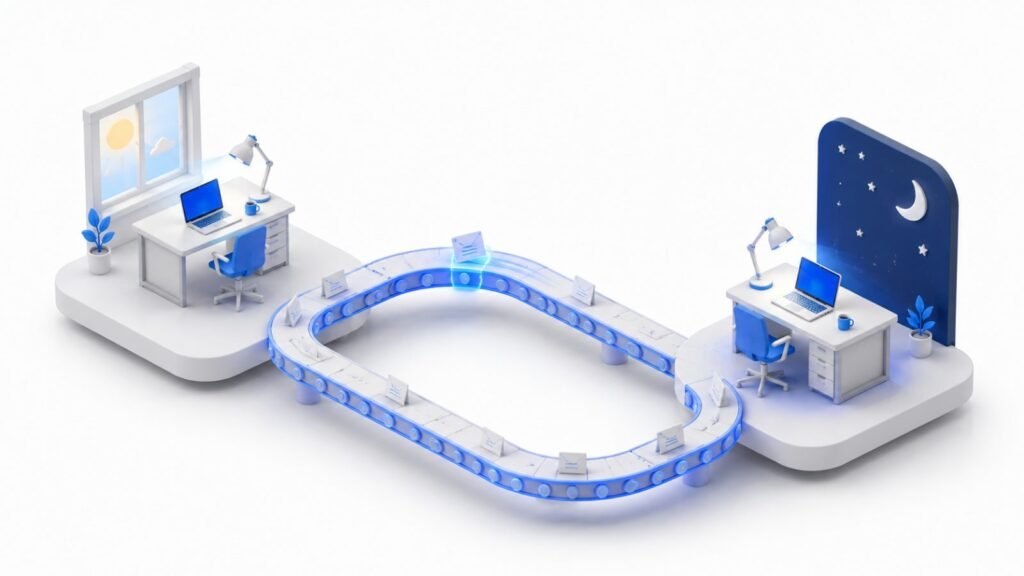
The Grammarly–Harris Poll research puts hard numbers on something every engineering lead feels daily: business leaders estimate their teams lose an average of 7.47 hours per week to poor communication — almost one full workday — and 72% of leaders say their team struggled to communicate effectively over the previous year. Now add a 9.5–12.5 hour time difference. When a teammate in San Francisco reads your update at their 9am and you are asleep in Chennai, a vague “working on it, will update soon” costs a full day: they cannot ask a follow-up question until your tomorrow. One precise paragraph — what shipped, what broke, what you need — is worth more to that team than an extra hundred lines of code, because it is the difference between a 24-hour loop and a zero-hour one.
Remote teams run on documents, not meetings
GitLab — the company that scaled to over a thousand employees with no offices at all — found in its Remote Work Report that 50% of remote professionals prefer shared documents over meetings for communication, and its famously public handbook runs thousands of pages precisely so decisions live in writing rather than in someone’s memory. This is the culture you are applying into. In an async-first team, you don’t attend most discussions — you read them and write into them. The intern whose issue comments are precise gets trusted with bigger tickets; the one whose messages need three clarifying replies gets quietly routed around. Combined with the reality that your live overlap with a US team is only 2–4 hours a day, writing is not a soft skill in this lane. It is the delivery mechanism for everything else you know.
The written-communication practice loop
- Adopt the three-line daily update. Shipped / blocked / next — every working day, even on solo projects. This single habit is the one remote teams most wish their interns arrived with.
- Write PR descriptions like a reviewer is busy. One line on what changed, one on why, one on how you tested it, and a screenshot if there is UI. Practise in your open-source contributions — every merged PR doubles as writing proof.
- Ask blocked questions the async way. State what you tried, what you expected, what happened, and your best guess — then your question. This converts “help me” into “confirm my direction,” which gets answered in one round-trip.
- Make your README explain decisions, not features. Why this stack, what trade-off you took, what you would do differently. Founders read READMEs the way recruiters read résumés.
- Prefer short sentences and concrete nouns. “The webhook retries three times, then dead-letters” beats a paragraph of hedging. Clarity reads as competence; padding reads as doubt.
- Re-read your last five cold emails as a founder would. If any sentence could apply to any company, cut it. Specific observation plus linked proof plus your overlap hours is the entire formula.
- Collect your best writing in one place. Two great PR descriptions, one design note, one week of daily updates — a writing portfolio takes an evening to assemble and answers the question every remote employer is silently asking.
Where Tierones fits
Tierones exists because a US founder cannot easily tell, from across the planet, which student is real and which proof is theirs. Verification handles the first problem; your Tierones profile compresses the second — and clarity is scored into it deliberately, because the commits, reviews and shipped projects that make up your rank all carry your writing with them. A precise PR description is not garnish on the proof. It is proof. The students who get matched first are the ones whose public trail already reads like a teammate’s, and second year — before placement pressure eats your calendar — is the cheapest time you will ever have to build that trail.
FAQ
Why do US remote teams care so much about written communication?
Because most of a remote team’s work happens in writing: pull-request descriptions, issue threads, shared documents and async updates. Grammarly and The Harris Poll estimate poor communication costs US businesses up to $1.2 trillion a year — about $12,506 per employee — so a founder screening a remote intern is directly screening for whether your writing will add to that cost or reduce it. Your first cold email, your GitHub README and your PR descriptions are read as work samples.
How good does my written English need to be for a US-remote internship?
Clear beats fancy. US teams are not grading grammar for its own sake; they are checking whether your writing transfers context reliably — what you did, what is blocked, what you need. Short sentences, concrete nouns, and a consistent daily-update format matter far more than vocabulary. A student who writes plain, precise updates will outperform a fluent writer who is vague about status.
How can a student practice async communication before their first remote role?
Use the public channels you already have. Write real PR descriptions and issue comments in open-source projects, keep a README that explains decisions rather than listing features, and practise a daily three-line update — shipped, blocked, next — on your own projects. After a few weeks you will have a public trail of exactly the artifacts a US founder screens for, attached to real code.
Building in second year at an IIT, NIT or IIIT? Tierones is an Tier-1-only network where verified students get matched to startups that hire on proof of work — sign up free with your .ac.in email and your GitHub.