

India just became the single largest source of open-source contributors on Earth. GitHub’s Octoverse 2025 report ranks India first for total contributors to public and open source projects, after adding over 5 million new developers in one year. For a second-year student, that is not trivia — it means the highest-leverage hiring signal you can build is free, public, and reviewed by strangers: a merged pull request.
Key takeaways
- India now ranks #1 worldwide for open-source contributors on GitHub, with 21.9 million developers and a projected 57.5 million by 2030.
- The Linux Foundation found 93% of hiring managers say open source talent is difficult to find — a merged PR puts you in the pool they are struggling to fill.
- A merged PR beats a certificate because it is third-party verified: a maintainer with no reason to flatter you reviewed the code and accepted it.
- Your first contribution should come from a repo you already use — fixing a bug you have personally hit beats hunting random “good first issue” labels.
The market just moved to your side of the table
The Octoverse numbers describe a shift, not a blip. GitHub now hosts more than 180 million developers, with over one new developer joining every second — and India supplied 14% of all new accounts in 2025, growing from 4.5 million developers in 2020 to 21.9 million today. GitHub’s own modelling projects 57.5 million Indian developers by 2030, one in every three new developers worldwide. The country that produces the most new programmers now also produces the most open-source contributors, which means the global default way to inspect an Indian engineer’s work is their public repo history.
Demand is running ahead of supply. The Linux Foundation’s Open Source Jobs Report found that 93% of hiring managers report open source talent is increasingly difficult to find, and 46% planned to increase open source hiring within six months. You do not need to be a kernel maintainer to benefit from that gap. You need evidence that you can enter an unfamiliar codebase, follow its rules, and land a change — which is precisely what one merged PR demonstrates.
Why a merged PR outranks a certificate
A course certificate says you watched something. A merged pull request says a stranger with commit rights — someone with zero incentive to be nice to you — read your code, pushed back, made you fix things, and then accepted it into software real people run. It is proof of the exact loop internships are made of: read unfamiliar code, scope a small change, survive review, ship. That is why we tell students a GitHub profile gets minutes while a résumé gets seconds: recruiters can skim claims, but engineers can read diffs. A PR conversation thread is the closest thing a second-year student has to a public code review reference.
Pick the repo before you pick the issue
The classic beginner mistake is opening an aggregator, sorting by “good first issue,” and parachuting into a project you have never run. Reverse it: list the open-source tools you already use — your web framework, a CLI you like, a library from a college project — and go read their issue trackers. A bug you have personally hit is one you can reproduce, explain, and test, which is 80% of the work. Aggregators like goodfirstissue.dev and First Timers Only are useful for discovering active, beginner-friendly projects, and Indian startups increasingly run serious open source themselves — Juspay’s Hyperswitch publishes its own beginner contribution guide. Wherever you land, read CONTRIBUTING.md first and comment on the issue before writing code; unclaimed and recently-active beats prestigious and dormant.
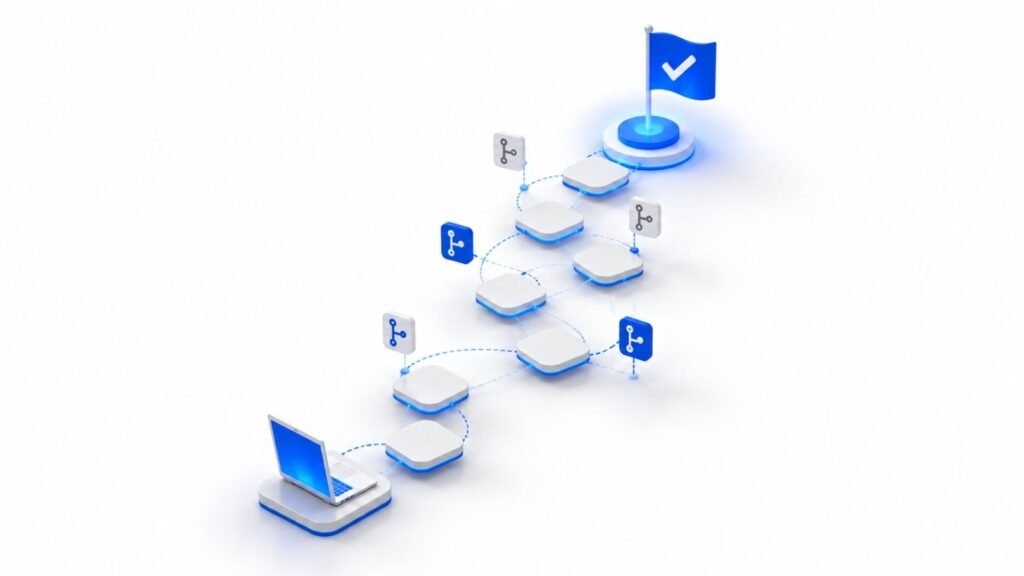
The first-PR playbook
- Shortlist 3 repos you actually use. Confirm each had commits in the last month and that maintainers respond to issues within days.
- Run the project from source. Clone it, build it, run the test suite. If the setup docs are wrong, congratulations — you just found your first contribution.
- Read CONTRIBUTING.md and the PR template. Every project has house rules on branches, commit messages and tests. Following them is the signal.
- Claim a small, unclaimed issue. Comment with your plan in two sentences and wait for a maintainer nod before investing hours.
- Make the change small and tested. One issue, one branch, one focused diff. Add or update a test even if nobody asked — it is the cheapest way to look senior.
- Write the PR description for a tired reviewer. What was broken, what you changed, how you verified it. Link the issue.
- Treat review comments as the actual interview. Respond within a day, fix without ego, ask when unsure. Maintainers remember contributors who iterate gracefully.
- After the merge, do it again. One merged PR is a data point; three in the same project is a track record, and you will be reviewing the ecosystem-wide flood of first-timers behind you.
Where this fits in your second-year plan
Open-source contributions slot directly into the proof-of-work ladder that startups hire on: real commits, reviewed code, shipped changes. At Tierones, merged PRs in active projects are exactly the kind of evidence that moves a student’s Tierones profile, because they are third-party verified by construction — nobody can inflate a maintainer’s approval. If your profile today is coursework plus one college project, a quarter spent landing three PRs in a library you genuinely use will do more for how employers read you than any certificate you could buy. The market data says the door is open; the playbook above is how you walk through it.
FAQ
How do I find a good first issue to contribute to?
Start inside repositories of tools you already use — a bug you have personally hit is the easiest issue to fix well. Aggregators like goodfirstissue.dev and firsttimersonly.com surface beginner-labelled issues across popular projects, but always read the repo’s CONTRIBUTING.md and check that the issue is unclaimed and recently active before you start.
Do employers actually look at open source contributions?
Yes, because a merged pull request is verifiable in a way a certificate never is. The Linux Foundation’s Open Source Jobs Report found 93% of hiring managers say open source talent is difficult to find, and a merged PR shows a stranger with commit rights reviewed your code and accepted it — public, third-party evidence of how you work.
Does my first contribution have to be code?
No. Documentation fixes, failing-test reproductions and issue triage are real contributions that teach you the fork-branch-PR-review workflow on lower stakes. For hiring signal, though, aim to progress to code within your first few PRs — the strongest proof is a change to behaviour that a maintainer reviewed and merged.
Building in second year at an IIT, NIT or IIIT? Tierones is an Tier-1-only network where verified students get matched to startups that hire on proof of work — sign up free with your .ac.in email and your GitHub.