
Recruiters spend an average of 7.4 seconds on a first skim of a resume, according to an eye-tracking study by Ladders (HR Dive). Seven seconds is not enough to believe anything, so a software internship resume cannot convince anyone of your skill. Its job is narrower: get the reader to click through to work they can check — and everything on the page should serve that or come off.
Key takeaways
- Treat the resume as a routing document. The proof lives at the links; the page decides whether anyone follows them.
- The “75% of resumes are rejected by ATS” statistic has no study behind it. A human is usually the one saying no.
- AI-written applications have made claims cheap, so reviewers trust evidence and discount adjectives.
- Several Indian resume habits — photo, date of birth, career objective, declaration — spend space a US startup reader does not want filled.
The ATS is not the one rejecting you
Every resume guide eventually warns that applicant tracking systems reject 75% of resumes before a human sees them. That number traces back to Preptel, a company that sold resume-optimisation services and went out of business in 2013 without ever publishing a method (HiringThing). When Enhancv interviewed 25 US recruiters in late 2025, 92% said their ATS does not auto-reject on formatting, content or design; the rejections that do happen mostly come from eligibility questions (Enhancv). It is a small sample from a company that sells resume software, so read it as testimony rather than a census, but it agrees with how small startups hire: the founder reads the inbox.
That changes what to optimise. Stuffing keywords for a machine is wasted effort. Writing for a tired human who will give you seconds is the whole game.
Why claims stopped working
The tired human has a reason to be sceptical. LinkedIn data reported by The New York Times in 2025 put applications at about 11,000 a minute, up more than 45% in a year (Marketing AI Institute). Greenhouse’s 2025 survey of 4,136 job seekers and hiring staff found 91% of recruiters had spotted candidate deception, 34% spend up to half their week filtering spam and junk applications, and 22% of hiring managers had caught prompt injections hidden in resumes (Greenhouse). Never do the last one; it is the fastest way to be remembered for the wrong reason.
When anyone can generate “passionate full-stack developer with strong problem-solving skills” in a second, that sentence carries no information. Employers still want the underlying thing — NACE’s Job Outlook 2025 found nearly 90% of employers look for evidence of problem-solving on a student’s resume (NACE). The operative word is evidence. A line that says what you built, who used it and where to see it is evidence. An adjective is not.
What to cut for a US startup reader
Indian templates carry fields a US reader does not expect. US career offices tell students to leave out age or date of birth, marital status and religion, and not to include a photograph (Pomona College Career Development Office). Father’s name, a “declaration” that everything is true, and a three-line career objective fall in the same bucket — not harmful, just space spent on nothing the reader came for.
Keep your CGPA. Indian employers gate on it and a US founder will not penalise a decent one; we covered which doors it opens in does CGPA matter for internships. Cut the twenty-item skills list: a reader cannot verify “Python, Java, C++, React, Node, Docker, Kubernetes, AWS” and assumes most of it is a tutorial.
On length, be honest about the data. A ResumeGo hiring experiment found reviewers somewhat preferred two-page resumes, even for entry-level roles (ResumeGo). The case for one page is not preference; it is the seven-second skim. If your best project is on page two, for most readers it does not exist.
The one-page build, top to bottom
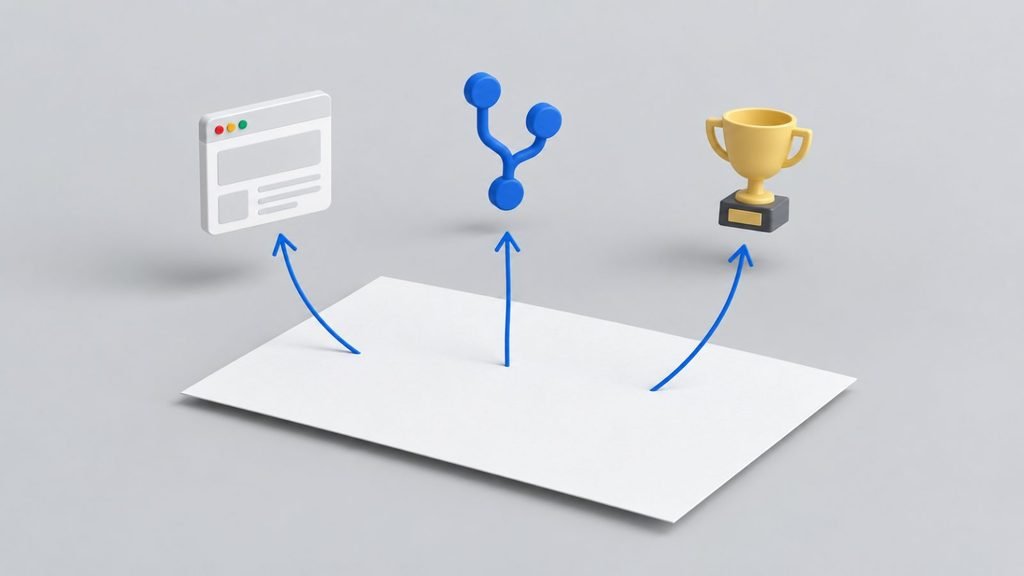
- Header: name, email, phone, three links. GitHub, your best deployed project, and one contest or portfolio profile. Make them real hyperlinks in the PDF, and test each one from a phone.
- Education in two lines. Institute, degree and branch, expected graduation, CGPA. Nothing about school unless you have nothing else yet.
- Projects before skills, and before any “experience” that was a certificate course. Two or three, each with a live link and a repository link.
- Three lines per project: what it does, the hard decision, the result. “Rewrote the search from a full scan to an index after it timed out past 10,000 rows” beats “Built a scalable app using MERN”. Only state numbers you can defend on a call.
- Real users, if you have any. “Used by 40 students in my hostel for mess feedback” is stronger proof than a star count. See building projects strangers use.
- Skills: only what appears in a project above. If it cannot be traced to a link on the page, delete it.
- Cut photo, date of birth, father’s name, objective and declaration. Put the space into another project line.
- Run the seven-second test. Show the page to a friend for seven seconds, take it away, and ask what they remember. If it is not your best project, reorder.
Make the links worth the click
A resume that routes well only helps if the destination holds up, so fix your GitHub profile before you send anything, and consider a short walkthrough video of your best project. Tierones goes one step further: your profile carries the proof itself — commits, contest ratings, shipped projects and a code walkthrough — so a startup founder sees the evidence instead of a claim about it. It is free, and it is how students from IITs, NITs and IIITs reach startups hiring remote interns. Start at tierones.io/students.
FAQ
Should a software engineering internship resume be one page?
For a student, one page is the safer default, but not because recruiters demand it — a ResumeGo experiment found a mild preference for two pages even at entry level. The reason is the skim: a first look lasts seconds, so everything that matters has to be visible in it.
Do applicant tracking systems automatically reject resumes?
Mostly not on formatting. The “75% rejected by ATS” claim traces to a resume-optimisation firm’s sales material with no published study. In interviews with 25 US recruiters, 92% said their ATS does not auto-reject on formatting, content or design.
Should I put a photo and date of birth on my resume for a US company?
No. US career offices advise leaving out photographs, date of birth, marital status and religion, partly because employers try not to see information they cannot use in a decision. Use the space for links to work a reviewer can check.
Ready to let your work speak before your resume does? Create your profile with your .ac.in email and link your GitHub — it takes a few minutes.