
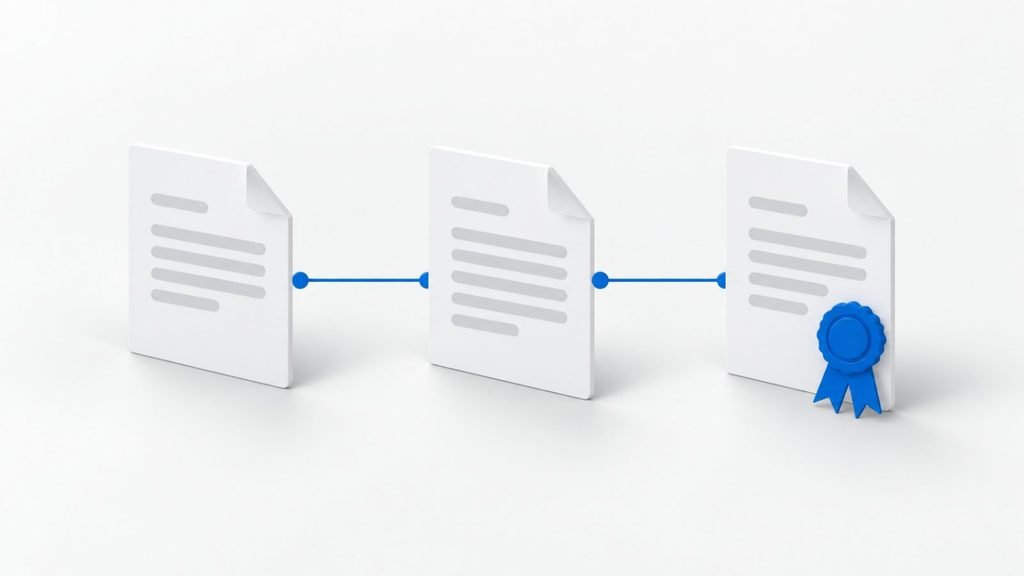
If you hire a student intern in India, expect three requests within the first fortnight: an offer letter, a signed evaluation sheet, and an internship certificate. The reason is the national internship policy. AICTE’s policy describes a sequence of provisional offer letter, no-objection certificate from the institute, final offer letter from the industry supervisor, a training report, and then an Internship Certificate from you, and it ties college credit to the whole chain (AICTE Internship Policy, as hosted by SRES Pune). A startup that cannot produce these pieces costs its intern credit at their college.
Key takeaways
- Engineering students can count 14 to 20 credits of internship (10 to 14 for diploma students), at a minimum of about 45 hours a credit.
- You are asked for three documents: an offer letter, a signed evaluation sheet and report, and a certificate.
- The policy does not publish a mandatory certificate template; a signed letter with the facts is what colleges look for.
- Put intellectual-property assignment in the offer letter, because the default rule depends on whether the intern is an employee or apprentice.
Why the paperwork matters to the student
The policy states that 14 to 20 credits of internship count towards a B.Tech or B.E. degree, and 10 to 14 for a diploma, with one credit being at minimum 45 hours. Fourteen credits therefore comes to about 630 hours, which is the kind of thing a full-time summer placement covers. The policy also says internships are full-time in summer and winter vacations and part-time during the academic session. (Some copies of the policy circulating online say 40 to 45 hours a credit; the SRES copy we cite says 45.)
So a student asking you for a signed letter is not being fussy. The credit, and in a few colleges the student’s final grade for the term, depends on your signature.
The three documents, in the order they are asked for
1. The offer letter
In the policy’s sequence the student first gets a provisional offer, takes it to the institute’s training and placement cell for a no-objection certificate, and then needs a final offer letter from the industry supervisor. Keep it to one page: name, college, role, start and end dates, hours a week, who they report to, what they will work on, and how they will be evaluated. If you pay a stipend, state it here in the currency you will pay in, and say plainly if you do not.
This is also the right place to say who owns the work. Under section 17 of the Copyright Act 1957, the employer is the first owner of a work made “in the course of the author’s employment under a contract of service or apprenticeship”, “in the absence of any agreement to the contrary” (Copyright Act 1957, s.17, Indian Kanoon). Whether an unpaid or contractor intern fits that wording is a legal question, so do not rely on the default. Add an assignment clause and have a lawyer check it.
2. The evaluation sheet and the supervisor’s signature
This is the document startups are least ready for. The policy says the intern’s diary and report go to the faculty mentor with an attendance record and an evaluation sheet “duly signed and stamped by the industry”. The student’s training report must be signed by the internship supervisor, and the industry supervisor evaluates it on five criteria: originality, an adequate and purposeful write-up, organisation and format, variety and relevance of learning, and practical applications. The industry evaluation also scores punctuality, eagerness to learn, the diary and a skill test, each on a scale of 1 to 10 (AICTE policy, chapters 4 and 5).
A remote company usually has no stamp. Tell the student in week one what you will sign with instead, and ask them to confirm with their faculty mentor that the college accepts it. If you already run a structured review, our intern evaluation rubric maps neatly onto the sheet.
3. The internship certificate
After the student submits the report, the policy says the industry issues the Internship Certificate. We found no mandatory template in the policy, so a plain signed letter on company letterhead is what most colleges accept. Include the student’s full name and college, the start and end dates, the hours worked, the role, two or three lines on what they actually built, and the supervisor’s name, title and work email. Be specific in the description. A certificate that says “worked on various tasks” is worth little to the student and says little about your company.
For internships found through AICTE’s own portal, the policy also describes a certificate verifiable on the portal, with credits recorded in the Academic Bank of Credits. If your intern came through a different route, the signed letter is what you issue.
A one-page checklist you can reuse
- Before day one: send the offer letter with scope, dates, weekly hours, supervisor, evaluation method and the IP clause.
- Week one: ask for the college’s evaluation form and agree how you will sign it without a stamp.
- During the internship: note the student’s leave. The policy allows one day in four weeks and two days in six weeks, with an email to both the faculty mentor and you a day before.
- Last week: read the diary and report, sign the report, and complete the evaluation sheet.
- Within a few days of finishing: issue the certificate while the work is fresh in your head.
Where this fits with the rest of hiring
Paperwork is the cheapest part of an internship to get right, and the part most likely to be remembered by the student. The expensive parts are scoping and onboarding: see our guides on scoping a remote intern project and onboarding in the first 30 days, and if you are structuring the engagement itself, hiring an Indian student as a contractor. Tierones students come with a profile of their projects, links and a recorded walkthrough, so you can judge the work before you write the offer letter.
FAQ
What does an internship certificate need to include?
AICTE’s internship policy does not publish a mandatory certificate template. It says the industry issues an Internship Certificate after the student submits the training report, and the supervisor signs the report and the evaluation sheet. A plain letter on company letterhead stating the student’s name, college, dates, role and what they worked on, signed by the supervisor, covers what colleges ask for. Check the student’s college for anything extra.
Do I have to issue an offer letter to an intern?
If the student wants college credit, in practice yes. The AICTE policy describes a provisional offer letter, then a no-objection certificate from the institute, then a final offer letter from the industry supervisor. A short written offer also protects you, because it is where you state the scope, dates and who owns the work.
Who owns the code an intern writes?
Under section 17 of the Copyright Act 1957, the employer is the first owner of a work made in the course of employment under a contract of service or apprenticeship, in the absence of any agreement to the contrary. Whether an unpaid or contractor intern falls under that rule is a legal question, so put an assignment of rights in the offer letter and have a lawyer review it.
Hiring interns from Indian colleges? Tell us the role and we’ll show you proof, not CVs. This post is general information, not legal advice.